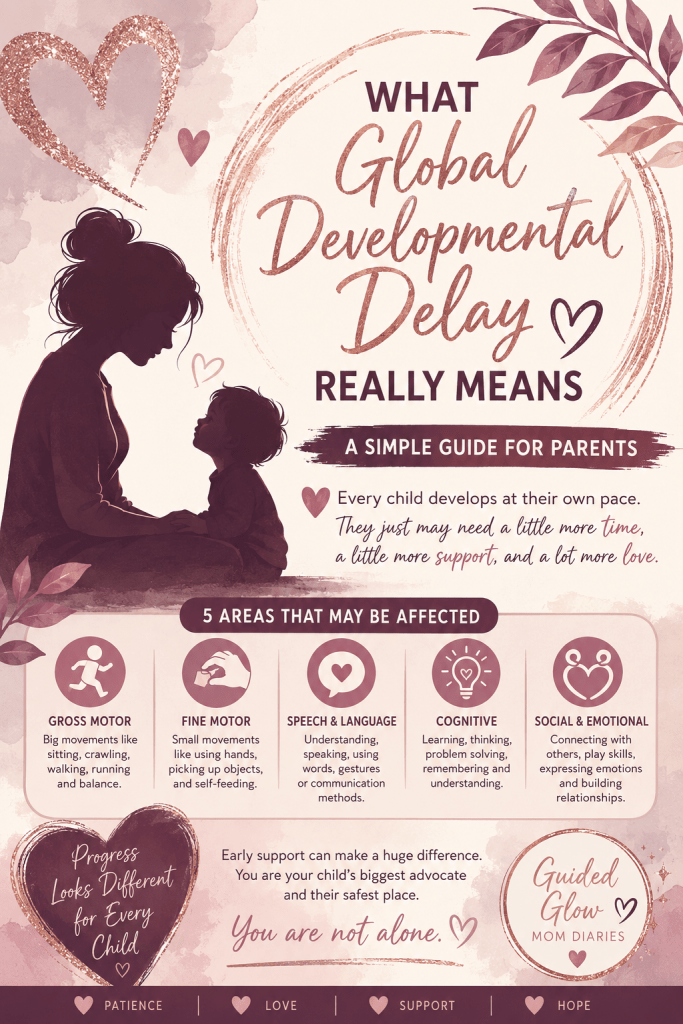
If you’ve recently heard the words “Your child has Global Developmental Delay,” you probably walked away with more questions than answers.
I know that feeling.
Your heart sinks. Your mind starts racing. You wonder…
“What does this actually mean?”
“Will my child catch up?”
“Did I do something wrong?”
“What happens next?”
Take a deep breath.
Let’s break it down in the simplest way possible.
What Is Global Developmental Delay?
Think about development like climbing a staircase.
Most children learn new skills one step at a time.
They smile.
They sit.
They crawl.
They walk.
They point.
They talk.
They learn to play.
They begin solving little problems.
Children with Global Developmental Delay (GDD) are climbing the same staircase—but they may need more time, more practice, and more support to reach each step.
They’re still learning.
They’re just learning at a different pace.
Why Is It Called “Global”?
The word global doesn’t mean it’s happening everywhere in the world.
It means more than one area of development is affected.
Doctors usually look at five main areas:
1. Gross Motor Skills
These are the big movements.
Examples include:
- Rolling over
- Sitting up
- Crawling
- Walking
- Running
- Jumping
2. Fine Motor Skills
These involve smaller hand movements like:
- Picking up food
- Holding a spoon
- Stacking blocks
- Coloring
- Using scissors later on
3. Speech and Language
This includes much more than talking.
It also means understanding words, following directions, pointing to communicate, making sounds, and using gestures.
Some children are completely non-speaking.
Others use a few words.
Some communicate with signs, pictures, or communication devices.
Every child communicates differently.
4. Cognitive Skills
This is how children learn and think.
Examples include:
- Solving simple problems
- Understanding cause and effect
- Learning colors
- Matching objects
- Pretend play
- Following routines
5. Social and Emotional Skills
These include:
- Making eye contact
- Playing with others
- Taking turns
- Showing emotions
- Building relationships
- Understanding social cues
What Does a Diagnosis Actually Mean?
A diagnosis of Global Developmental Delay is not a prediction of your child’s future.
It’s simply a way of saying:
“Right now, your child is developing more slowly than expected in multiple areas and needs extra support.”
That’s all.
It doesn’t tell you how far they’ll go.
It doesn’t define their intelligence.
It doesn’t define their personality.
And it certainly doesn’t define their worth.
Every Child’s Journey Is Different
Some children make huge gains with therapy.
Some continue needing lifelong support.
Others eventually receive a more specific diagnosis, such as autism, a genetic condition, or an intellectual disability as they get older.
Every child has their own path.
There is no single timeline.
Why Early Intervention Matters So Much
One of the biggest gifts you can give your child is early intervention.
A young child’s brain is incredibly adaptable. The earlier children receive support, the more opportunities they have to build important skills.
Services may include:
- Speech therapy
- Occupational therapy
- Physical therapy
- Feeding therapy
- Developmental therapy
- Early childhood education
Therapy isn’t about changing who your child is.
It’s about giving them the tools they need to communicate, learn, move, and become as independent as possible.
What Parents Can Do at Home
You don’t have to be a therapist to make a difference.
Simple everyday moments matter.
Try things like:
- Reading together every day
- Singing songs
- Narrating your daily routine
- Playing on the floor
- Practicing taking turns
- Offering sensory play
- Celebrating every small win
Progress often happens one tiny step at a time.
If You’re Feeling Overwhelmed…
You’re not alone.
Hearing “Global Developmental Delay” can feel scary.
It’s okay to grieve the expectations you had.
It’s okay to feel uncertain.
But remember this:
Your child is still the same child they were before the diagnosis.
They still smile.
They still laugh.
They still need your hugs.
They still deserve to be celebrated for who they are—not just for the milestones they reach.
Our Journey
When our son was diagnosed with Global Developmental Delay, we didn’t suddenly have all the answers.
What we did have was a choice.
We could focus only on everything he wasn’t doing…
Or we could celebrate every little victory.
Every new sound.
Every new skill.
Every moment of connection.
Some days are hard.
Some days are incredibly rewarding.
We’ve learned that progress isn’t always measured in giant leaps. Sometimes it’s found in the smallest moments that most people never notice.
Those moments deserve celebrating too.
Final Thoughts
Global Developmental Delay isn’t the end of your child’s story.
It’s simply one chapter.
Your child is not broken.
They are growing in their own way, at their own pace.
With love, support, patience, and the right therapies, many children continue making meaningful progress over time.
So if you’re standing where we once stood—confused, scared, and searching for hope—know this:
There is hope.
One step.
One milestone.
One victory at a time.

 Just Mommy & Me Blog
Leave a comment