If you’ve ever watched your child suddenly cover their ears, cry over a tag in their shirt, melt down in a crowded grocery store, or completely shut down after what seemed like a normal day, you know how heartbreaking it can feel.
To others, it may look like a tantrum.
But for many children—especially those with autism, ADHD, sensory processing differences, or developmental delays—it may actually be sensory overload.
Learning to recognize sensory overload changed the way I parent. Instead of asking, “Why is my child acting this way?” I began asking, “What is my child experiencing right now?”
That simple shift changed everything.
What Is Sensory Overload?
Sensory overload happens when a child’s brain receives more sensory information than it can comfortably process.
Our brains constantly take in information through our senses:
- Sight
- Sound
- Touch
- Taste
- Smell
- Movement (vestibular system)
- Body awareness (proprioception)
Most people naturally filter unnecessary information.
Some children cannot.
Imagine walking into a room where:
- The lights are painfully bright.
- Multiple people are talking at once.
- Music is blaring.
- Your clothes feel scratchy.
- Someone keeps touching your shoulder.
- A strong smell fills the room.
Now imagine having no way to escape.
That’s what sensory overload can feel like.
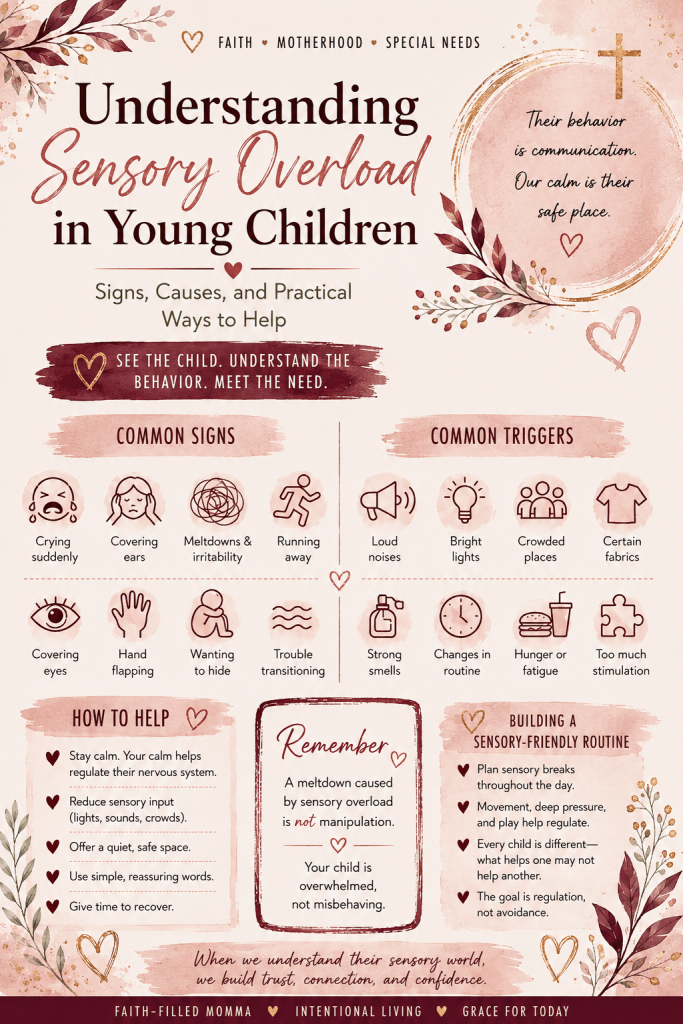
Common Signs of Sensory Overload
Every child is different, but common signs include:
Emotional Signs
- Crying suddenly
- Irritability
- Anxiety
- Panic
- Aggression
- Wanting to hide
Physical Signs
- Covering ears
- Squinting or covering eyes
- Rocking
- Hand flapping
- Spinning
- Running away
- Freezing completely
Behavioral Signs
- Refusing tasks
- Throwing toys
- Meltdowns
- Difficulty listening
- Trouble transitioning
- Clinginess
Remember: a meltdown caused by sensory overload is not manipulation. Your child is overwhelmed, not misbehaving.
What Can Trigger Sensory Overload?
Common triggers include:
- Loud restaurants
- Grocery stores
- Birthday parties
- Bright fluorescent lights
- Clothing tags
- Certain fabrics
- Hair brushing
- Vacuum cleaners
- Crowded places
- Strong smells
- Unexpected changes in routine
- Hunger or fatigue
Sometimes several small triggers build up throughout the day until your child reaches their limit.
Sensory Overload vs. Tantrums
This is one of the biggest misconceptions.
A tantrum often has a goal, such as getting something the child wants.
Sensory overload is different.
The child’s nervous system is overwhelmed. They aren’t trying to be difficult—they’re trying to survive the moment.
Instead of punishment, they need regulation.
How to Help During Sensory Overload
Stay calm. Your nervous system helps regulate theirs.
Reduce sensory input by:
- Turning off loud sounds
- Dimming lights
- Moving to a quiet room
- Speaking softly
- Offering space
Avoid asking lots of questions during a meltdown.
Instead, try saying:
- “You’re safe.”
- “I’m here.”
- “We’ll get through this together.”
After they’ve calmed down, don’t rush into teaching or correcting. Their brain needs time to recover.
Building a Sensory-Friendly Routine
Many occupational therapists recommend incorporating regular “sensory breaks” throughout the day. These planned activities can help children regulate before they become overwhelmed.
Ideas include:
- Jumping on a mini trampoline
- Swinging
- Pushing a laundry basket
- Carrying books
- Play-Doh
- Water play
- Bubble blowing
- Animal walks
- Deep-pressure hugs (only if your child enjoys them)
The goal isn’t to avoid sensory experiences forever. It’s to help your child learn how to regulate them.
My Favorite Sensory Products
These are popular tools that many parents and occupational therapists use to support regulation. Every child is different, so you may need to experiment to find what works best.
Sensory Swing (Great for Movement & Calming)
Gentle swinging provides calming vestibular input and a cozy place for quiet time.
Fidget Kit
Perfect for keeping little hands busy during transitions, waiting rooms, or school.
Oral Sensory Chew
Helpful for children who chew on shirts, sleeves, pencils, or toys.
Final Thoughts
If your child experiences sensory overload, know this:
You are not failing.
Your child is not “too much.”
Their brain simply experiences the world differently.
When we begin to understand sensory processing, we stop seeing “bad behavior” and start seeing unmet sensory needs.
And when children feel understood instead of judged, they often begin to thrive.
Every small step toward understanding your child’s unique sensory world is a step toward building trust, confidence, and connection. Your calm presence is one of the most powerful tools they have.




Leave a comment