Have you ever wondered why one child melts down in a noisy grocery store while another barely notices the chaos? Or why your child refuses to wear certain clothes, avoids hugs, constantly crashes into furniture, or seems to never stop moving?
At first, it can be confusing. You may hear comments like, “They’re just being picky,” “They’ll grow out of it,” or “They’re acting out.” But what if it isn’t behavior at all? What if your child’s brain is simply experiencing the world differently? That’s what sensory processing is all about.
As a mom walking this journey myself, learning about sensory processing completely changed the way I understood my son. Instead of asking, “Why is he doing this?” I started asking, “What is his nervous system trying to tell me?” That simple shift changed everything.
What Is Sensory Processing? 🧠
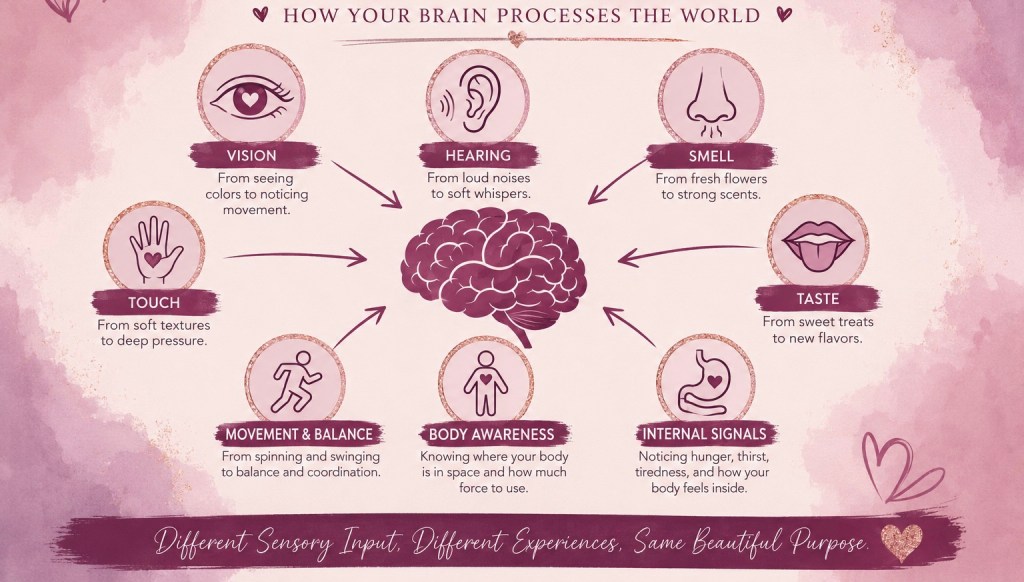
Think of your brain as the control center of your body. Every second, your eyes, ears, skin, muscles, joints, nose, mouth, and inner ears are sending millions of tiny messages to your brain.
Your brain’s job is to organize all of that information and decide what deserves attention.
For most people, this happens automatically.
You hear a dog barking. You notice it. Then your brain decides it isn’t important, and you move on.
Simple.
But for someone with sensory processing differences, that filtering system doesn’t always work the way it’s supposed to.
Their brain may:
- Turn the volume way up.
- Turn the volume way down.
- Become overwhelmed.
- Miss important information.
- Constantly search for more input.
Imagine trying to have a conversation while ten TVs are blasting at full volume around you. Or imagine trying to hear someone whisper across a football stadium. That’s what sensory processing challenges can feel like.
Our Eight Amazing Senses
Most people learn about five senses.
But our bodies actually rely on eight.
1. Touch (Tactile System) 👆👉👇👈
This helps us know:
- Hot vs. cold
- Soft vs. rough
- Pain
- Pressure
- Different textures
Some children love messy play.
Others can’t stand getting their hands dirty.
A shirt tag might feel like sandpaper.
A haircut might feel painful.
Even brushing teeth can feel overwhelming.
2. Hearing (Auditory System) 👂
This isn’t just about hearing sounds.
It’s about how the brain processes them.
A vacuum cleaner.
A hand dryer.
A birthday party.
A crowded restaurant.
For some children, these sounds don’t just seem loud.
They can actually feel painful.
Meanwhile, another child may constantly make loud noises because they’re seeking more auditory input.
3. Vision (Visual System) 👀
Some brains are very sensitive to visual information.
Bright lights.
Busy classrooms.
Crowded stores.
Flashing toys.
Too many colors.
All of these can overload the brain. Some children may avoid eye contact because looking at faces requires processing a huge amount of visual information. Others become fascinated by spinning fans, lights, or moving objects.
4. Taste (Gustatory System) 👅
This explains why many children have very limited diets.
It’s rarely about being stubborn.
Some foods may literally taste stronger or feel unbearable inside their mouth.
Crunchy foods.
Smooth foods.
Mixed textures.
Strong flavors.
The brain may reject them because they feel overwhelming.
5. Smell (Olfactory System) 👃
Some children notice smells that most people don’t.
Perfume.
Laundry detergent.
Cooking food.
Cleaning supplies.
Even someone else’s shampoo.
These smells can become distracting or upsetting. Others may seek strong smells because they help them regulate.
6. Body Awareness (Proprioception) 🖐️🦶
This is one of the most important senses that many people have never heard of.
Proprioception tells your brain where your body is without needing to look.
It’s why you can:
- Walk upstairs without watching your feet.
- Touch your nose with your eyes closed.
- Carry groceries.
- Write your name.
Children who struggle here may:
- Constantly bump into things.
- Break toys.
- Use too much force.
- Seem clumsy.
- Hug too hard.
- Crash into furniture.
They’re often looking for deep pressure because it helps their brain understand where their body is.
7. Balance and Movement (Vestibular System) 👣
Located inside the inner ear, this system helps with:
- Balance
- Movement
- Coordination
- Head position
- Gravity
Some children constantly spin.
Jump.
Swing.
Climb.
Run.
Rock.
Others avoid movement because it makes them dizzy or anxious. Both are signs their vestibular system may be processing movement differently.
8. Internal Body Signals (Interoception) 📶
This sense helps us notice what’s happening inside our bodies.
Am I hungry?
Am I thirsty?
Do I need the bathroom?
Is my heart racing?
Am I tired?
Am I anxious?
Some children don’t recognize these signals until they’re very intense. They may suddenly have accidents because they didn’t realize they needed the bathroom. Or they may seem angry when they’re actually hungry or exhausted.
Why Sensory Processing Affects Everyday Life
Sensory processing isn’t something that only happens during therapy.
It affects nearly every part of the day.
Getting Dressed
Clothes may itch.
Socks may feel “wrong.”
Shoes may feel tight.
Certain fabrics can feel unbearable.
What looks like stubbornness may actually be sensory discomfort.
Mealtime
Food isn’t just about taste.
Children also experience:
- Texture
- Smell
- Temperature
- Appearance
- Sound when chewing
A child who eats only a few foods often isn’t trying to be difficult.
Their nervous system simply feels safest with familiar foods.
Bath Time
Water pressure.
Soap.
Temperature changes.
Wet hair.
The feeling of drying off.
These sensations can quickly become overwhelming.
Haircuts and Tooth Brushing
These activities combine several senses all at once.
Touch.
Sound.
Smell.
Movement.
Pressure.
It’s no surprise many children struggle with them.
Sleep
A nervous system that spends all day working overtime often has trouble settling down. Some children become restless. Others wake frequently. Some need heavy blankets or deep pressure to help them feel calm enough to sleep.
Grocery Stores
Think about everything happening inside one store.
Bright fluorescent lights.
Music.
People talking.
Shopping carts.
Strong smells.
Cold air.
Announcements over the speakers.
Crowds.
It’s easy to see why many children become overwhelmed before you’ve even finished shopping.
Playgrounds
Some children avoid climbing because movement feels scary.
Others seek huge amounts of movement by climbing everything in sight.
Neither is “bad.”
Their nervous system is simply asking for different support.
Sensory Overload
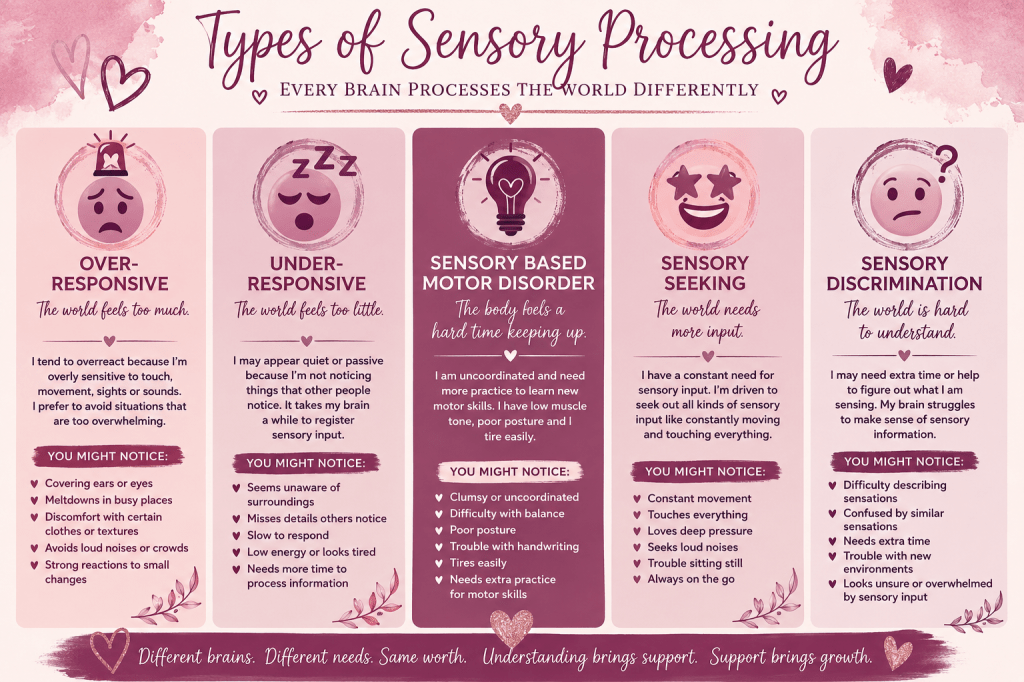
When too much sensory information enters the brain, it can become overloaded.
Think of your phone with 50 apps running at the same time.
Eventually, everything slows down.
The brain does something similar.
Children may:
- Cry
- Cover their ears
- Run away
- Freeze
- Yell
- Hide
- Hit
- Shut down completely
These aren’t usually choices.
They’re signs the nervous system has reached its limit.
Sensory Seeking
Some children have the opposite challenge.
Their brain craves more input.
You may notice they:
- Jump constantly.
- Spin.
- Crash into furniture.
- Chew on shirts.
- Bite toys.
- Climb everything.
- Run everywhere.
- Love rough play.
Their body is searching for the sensory information it needs to stay regulated.
A Sensory Diet: Fuel for the Nervous System
Just like our bodies need healthy food throughout the day, our nervous systems need the right kinds of sensory input.
A sensory diet isn’t about eating.
It’s a personalized plan of sensory activities that helps the brain stay organized and regulated.
Examples include:
- Swinging
- Jumping on a trampoline
- Pushing a laundry basket
- Carrying groceries
- Climbing
- Animal walks
- Deep-pressure hugs (if the child enjoys them)
- Play-Doh
- Water play
- Blowing bubbles
- Listening to calming music
- Using noise-reducing headphones when needed
The right sensory input at the right time can help children focus, learn, communicate, and participate more comfortably in everyday life.
Seeing Behavior Through a Different Lens
One of the biggest lessons I’ve learned is that behavior is communication.
Instead of asking:
“How do I stop this behavior?”
Try asking:
- What is my child feeling?
- Is their nervous system overwhelmed?
- Are they seeking sensory input?
- Is something in their environment too much?
- What support do they need right now?
That simple change in perspective can completely transform the way we respond to our children.
Final Thoughts
Sensory processing isn’t about being “bad,” “spoiled,” or “too sensitive.” It’s about how the brain receives, organizes, and responds to information from the world around us.
When we understand sensory processing, we stop expecting children to simply “push through” experiences that may genuinely feel overwhelming. Instead, we begin to see the world through their eyes.
With patience, understanding, early intervention, and the right supports, children can build the skills they need to feel more comfortable, confident, and successful in everyday life.
If your child struggles with everyday tasks like getting dressed, eating, playing, sleeping, or handling busy environments, know this: you are not alone. Learning about sensory processing is one of the most powerful first steps you can take. The more you understand your child’s nervous system, the better you can support them—and that understanding can make all the difference.




Leave a comment