Have you ever wondered why some children seem to absorb new skills with ease while others struggle to communicate, focus, or stay calm in everyday situations?
For many children with developmental delays, sensory processing differences, or autism, the answer isn’t simply behavior—it may begin with the nervous system.
Learning about the nervous system completely changed the way I look at my own son’s development. Instead of asking, “Why won’t he do this?” I started asking, “What is his nervous system experiencing right now?”
That one question changed everything.
Your Child’s Nervous System Is Their Body’s Control Center
Think of your child’s nervous system as their body’s control center. Every second, it’s taking in information from the world and deciding how to respond.
Its first job isn’t teaching your child to talk, learn, or play.
Its first job is to determine whether everything feels manageable.
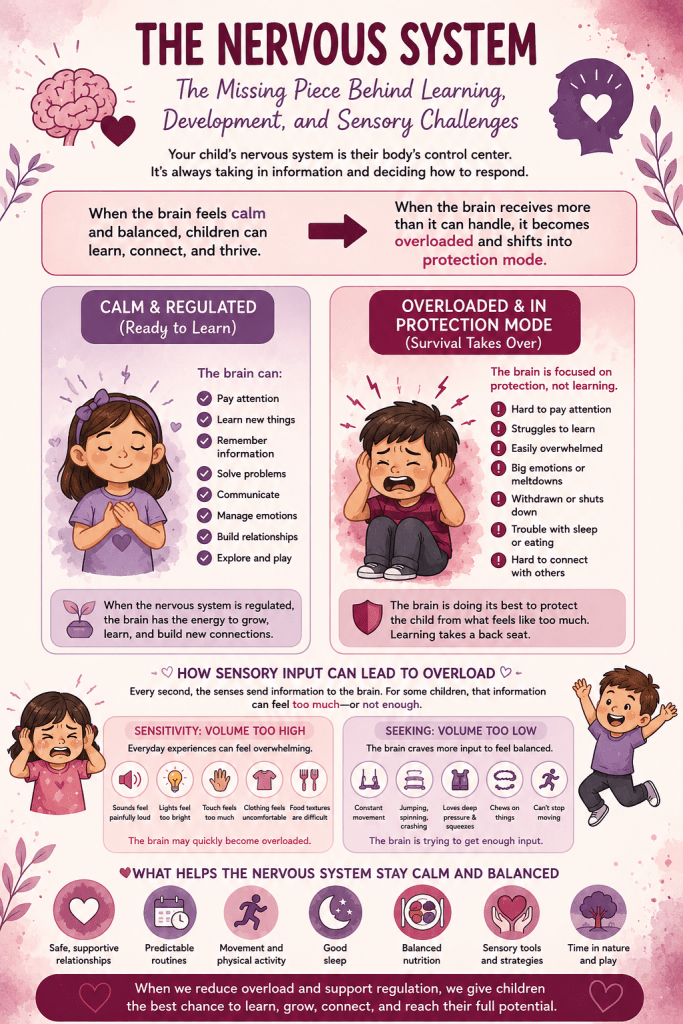
When the brain feels calm and balanced, children can focus on learning, exploring, communicating, and connecting with others.
But when the brain receives more information than it can comfortably process—whether from loud sounds, bright lights, busy environments, strong emotions, or other stressors—it can become overwhelmed.
This is called overload.
When overload happens, the nervous system shifts into protection mode. Instead of focusing on learning or problem-solving, the brain uses its energy to cope with what feels like too much stimulation.
That protection can look different for every child. Some cry or have a meltdown. Others cover their ears, run away, seek constant movement, become unusually active, or completely shut down.
These aren’t signs that a child is being difficult. They’re often signs that their nervous system is doing its best to manage more than it can comfortably handle.
A Regulated Nervous System Helps Children Learn
When a child’s nervous system is calm and regulated, the brain has room to grow.
Children are better able to:
- Pay attention
- Learn new words
- Develop speech and language
- Solve problems
- Remember information
- Play creatively
- Build friendships
- Manage emotions
- Explore their environment
This is when the brain builds and strengthens the neural connections that support healthy development.
What Happens During Overload?
When the nervous system becomes overloaded, the brain has to divide its attention.
Instead of focusing on learning, it’s working hard to organize all the sensory information coming in.
Imagine trying to read a book while five televisions are playing at full volume around you.
Even if you really want to read, it’s almost impossible to concentrate.
That’s what overload can feel like for some children.
Their brain is using so much energy trying to process the world around them that there isn’t much left for learning, communication, or problem-solving.
Over time, frequent overload can make it harder to develop skills because the brain has fewer opportunities to practice them in a calm, organized state.
So Where Does Sensory Processing Fit In?
This is where everything begins to connect.
Every second, your child’s senses send information to the brain.
They’re constantly processing:
- Sounds
- Lights
- Touch
- Smells
- Taste
- Movement
- Body position
- Temperature
The nervous system sorts through all of this information and decides what deserves attention and what can be filtered out.
For some children, that filtering system works differently.
A vacuum cleaner may sound painfully loud.
A shirt tag may feel unbearable.
Bright lights may seem overwhelming.
Certain food textures may make eating difficult.
Other children experience the opposite.
Their nervous system may crave more movement, deep pressure, jumping, spinning, crashing, or squeezing because their brain needs extra sensory input to stay organized.
Neither response is wrong.
It’s simply a different way of processing sensory information.
Think of It Like a Volume Knob
Imagine everyone has a volume knob inside their brain.
For some children, the volume is turned up very high.
Normal sounds feel extremely loud.
Gentle touches feel irritating.
Busy places become overwhelming very quickly.
For others, the volume is turned down.
They seek movement, pressure, and physical activity because their brain needs stronger sensory input to feel balanced.
When the volume is either too high or too low, everyday experiences become much harder to process.
Why This Affects Development
When a child’s brain is working overtime to organize sensory information, it has fewer resources available for learning.
It’s like trying to use a computer that’s running dozens of programs at the same time.
Everything slows down.
This can affect:
- Speech and language
- Attention
- Emotional regulation
- Memory
- Motor skills
- Social interaction
- Play skills
- Learning new concepts
The child isn’t refusing to learn.
Their brain is simply working harder than most people realize.
Regulation Comes Before Learning
One of the most important lessons I’ve learned is this:
Children learn best when their nervous system feels calm and organized.
Before expecting children to communicate, focus, or participate, we first have to help them feel regulated.
That doesn’t mean removing every challenge.
It means creating environments, routines, and supports that reduce overload and help the brain organize sensory information more effectively.
As regulation improves, learning often becomes easier because the brain has more capacity to build new skills.
Can the Nervous System Improve?
Yes.
The nervous system is remarkably adaptable.
Children’s brains continue to grow throughout childhood.
Supportive relationships, movement, quality sleep, balanced nutrition, play, therapy when appropriate, and consistent routines can all help strengthen regulation skills over time.
Progress is rarely linear.
Some days are easier than others.
But every calm, connected experience helps build stronger pathways for future learning.
A Final Thought
Whether your child has developmental delays, sensory processing differences, autism, ADHD, or simply experiences the world differently, remember this:
Behavior is often communication.
Instead of asking,
“What’s wrong with my child?”
Try asking,
“Could their nervous system be experiencing overload right now?”
Sometimes what looks like defiance is actually overwhelm.
Sometimes what looks like inattention is a brain trying to organize too much information.
Sometimes what looks like a tantrum is actually protection mode.
When we begin to understand the nervous system, we stop seeing difficult behaviors as problems to fix and start seeing them as messages to understand.
And when we help reduce overload and support regulation, we create more opportunities for our children to learn, grow, and thrive—one small step at a time.




Leave a comment