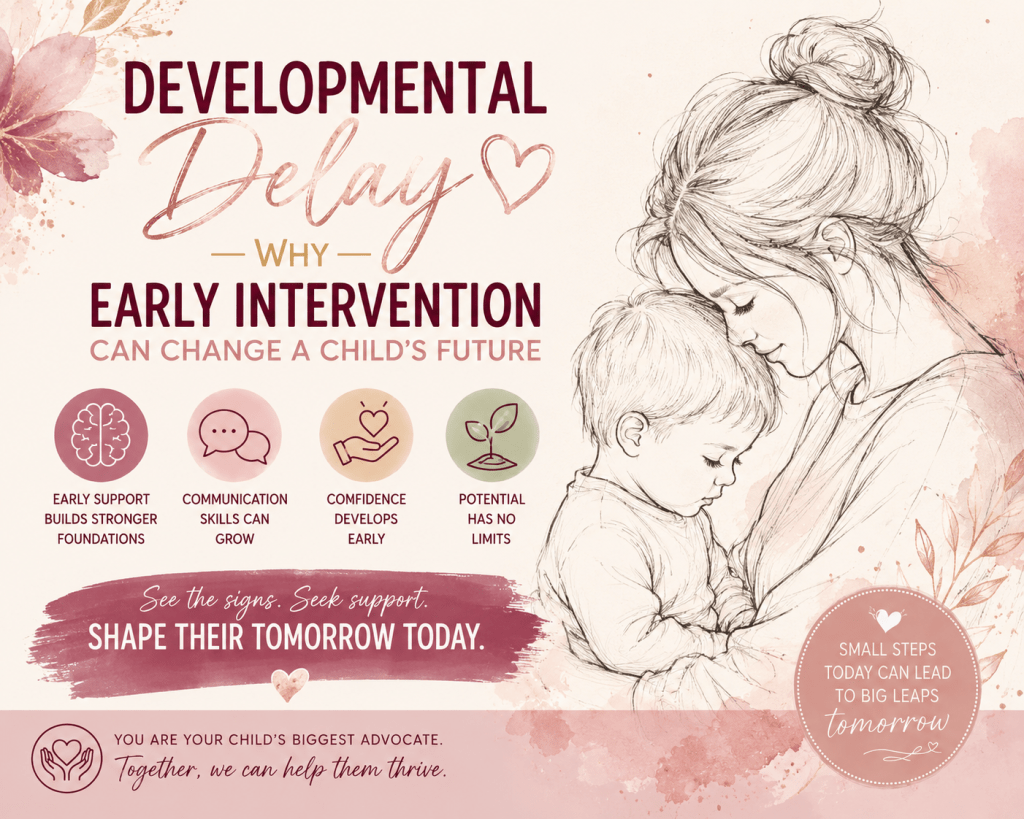
Developmental Delay Isn’t the End of the Story—It’s the Beginning of a Different Journey
The words “developmental delay” can stop a parent in their tracks.
Maybe your child isn’t talking yet.
Maybe they don’t point, respond to their name, make eye contact consistently, or meet milestones at the same pace as other children.
Maybe you’ve spent hours searching the internet, comparing your child to every toddler you see, wondering if you’re doing something wrong.
I know that feeling.
As a mom walking this journey, I’ve learned something I wish every parent knew:
A developmental delay is not a life sentence. It is a signal that your child may need extra support—and the earlier that support begins, the greater the opportunity for growth.
Every child develops differently, but when delays are recognized early, families gain something incredibly valuable: time.
Time to understand.
Time to learn.
Time to help.
And sometimes, time makes all the difference.
What Is a Developmental Delay?
A developmental delay happens when a child reaches milestones later than expected in one or more areas of development.
These areas include:
- Speech and language
- Motor skills (walking, running, climbing)
- Fine motor skills (using utensils, stacking blocks, drawing)
- Social and emotional development
- Cognitive skills (learning and problem-solving)
- Adaptive skills (feeding, dressing, daily routines)
Some children catch up quickly with support.
Others continue to need services throughout childhood.
Neither outcome changes one important truth:
Early support gives children the best chance to reach their full potential.
The Signs Parents Should Never Ignore
Parents often notice subtle differences long before anyone else.
Trust your instincts.
Some signs may include:
- No babbling or very few sounds
- Limited eye contact
- Doesn’t point to share interest
- Doesn’t respond consistently to their name
- Delayed speech
- Difficulty following simple directions
- Doesn’t imitate others
- Limited pretend play
- Walking later than expected
- Poor balance or coordination
- Sensory sensitivities
- Feeding difficulties
Seeing one or two of these signs does not automatically mean a child has a developmental disorder.
But it does mean it’s worth having a conversation with your pediatrician or requesting an evaluation.
Why Early Intervention Matters So Much
The first few years of life are when a child’s brain is developing at an incredible pace.
During this period, the brain forms millions of new connections through learning, play, movement, communication, and relationships.
This ability to adapt and strengthen connections—often called brain plasticity—is one reason early intervention can be so effective.
When children receive the right support early, they often make meaningful progress in areas such as:
- Communication
- Social interaction
- Motor skills
- Daily living skills
- Emotional regulation
- Learning readiness
- Independence
Early intervention doesn’t “fix” a child.
It helps build skills, reduce barriers, and support healthy development while empowering families with strategies they can use every day.
What Is Early Intervention?
Early intervention is a collection of services designed to help infants and young children with developmental delays or disabilities.
Depending on a child’s needs, services may include:
- Speech therapy
- Occupational therapy
- Physical therapy
- Feeding therapy
- Developmental therapy
- Behavioral supports
- Family education and coaching
Many services are play-based because children learn best through meaningful interactions and everyday routines.
Parents are an essential part of the process. Therapy doesn’t end when the appointment is over—it continues through daily life, from mealtime and bath time to reading books and playing on the floor.
The Power of Parents
No therapist spends more time with your child than you do.
That means your voice matters.
Your observations matter.
Your advocacy matters.
You don’t need to know all the answers.
You simply need to keep showing up.
Celebrate the small victories.
The first point.
The first word.
The first time they wave goodbye.
The first successful bite of a new food.
The first time they imitate a sound.
Progress isn’t always loud.
Sometimes it arrives in tiny moments that only a parent notices.
And those moments deserve to be celebrated.
What Parents Can Do at Home
You don’t need expensive toys to encourage development.
Simple, intentional interactions can make a big difference.
Try these daily activities:
- Read together every day.
- Narrate everyday routines.
- Sing songs with hand motions.
- Encourage turn-taking during play.
- Limit passive screen time.
- Get outside and explore nature.
- Play on the floor together.
- Practice gestures like waving, clapping, and pointing.
- Celebrate every attempt at communication.
- Follow your child’s interests.
Learning happens through connection.
You Are Not Behind
One of the hardest parts of parenting a child with developmental delays is comparison.
Social media often shows children hitting milestones on schedule.
What it doesn’t show are the therapy appointments, sleepless nights, evaluations, tears, worries, and victories happening behind closed doors.
Every child’s timeline is different.
Growth is not a race.
Progress is still progress.
Hope Lives Here
If you’re reading this while waiting for answers…
Waiting for evaluations…
Waiting for therapy…
Waiting for a diagnosis…
Please hear this:
Your child is more than a checklist of milestones.
They are worthy of love exactly as they are.
Early intervention isn’t about changing who your child is.
It’s about helping them communicate, connect, learn, and experience the world in ways that allow their unique strengths to shine.
As parents, we can’t control every outcome.
But we can choose to advocate.
We can choose to learn.
We can choose to believe that small steps still move us forward.
And sometimes those small steps become giant leaps.
Frequently Asked Questions
Can a child outgrow a developmental delay?
Some children catch up with time and appropriate support, while others continue to benefit from ongoing services. An evaluation can help determine what support may be helpful.
Does a developmental delay always mean autism?
No. Developmental delays can have many different causes, and not every child with a developmental delay is autistic. A thorough evaluation is the best way to understand your child’s needs.
When should I ask for an evaluation?
If you have concerns about your child’s development at any age, don’t wait. Early evaluation can help identify whether services are appropriate.
Can parents make a difference?
Absolutely. Parents play one of the most important roles by creating opportunities for communication, play, learning, and connection every day.
Final Thoughts
If I could leave every parent with one message, it would be this:
Never let anyone make you feel guilty for asking questions about your child’s development.
Seeking help isn’t giving up.
It’s showing up.
The earlier we recognize delays, the sooner children can receive support that helps them build skills, confidence, and independence.
Every milestone matters.
Every therapy session matters.
Every bedtime story matters.
Every hug matters.
And every child deserves the chance to reach their fullest potential—one small step at a time.
If this article encouraged you, share it with another parent who may need a reminder that they are not alone. Together, we can replace fear with hope, comparison with compassion, and uncertainty with action.

 Just Mommy & Me Blog
Leave a comment